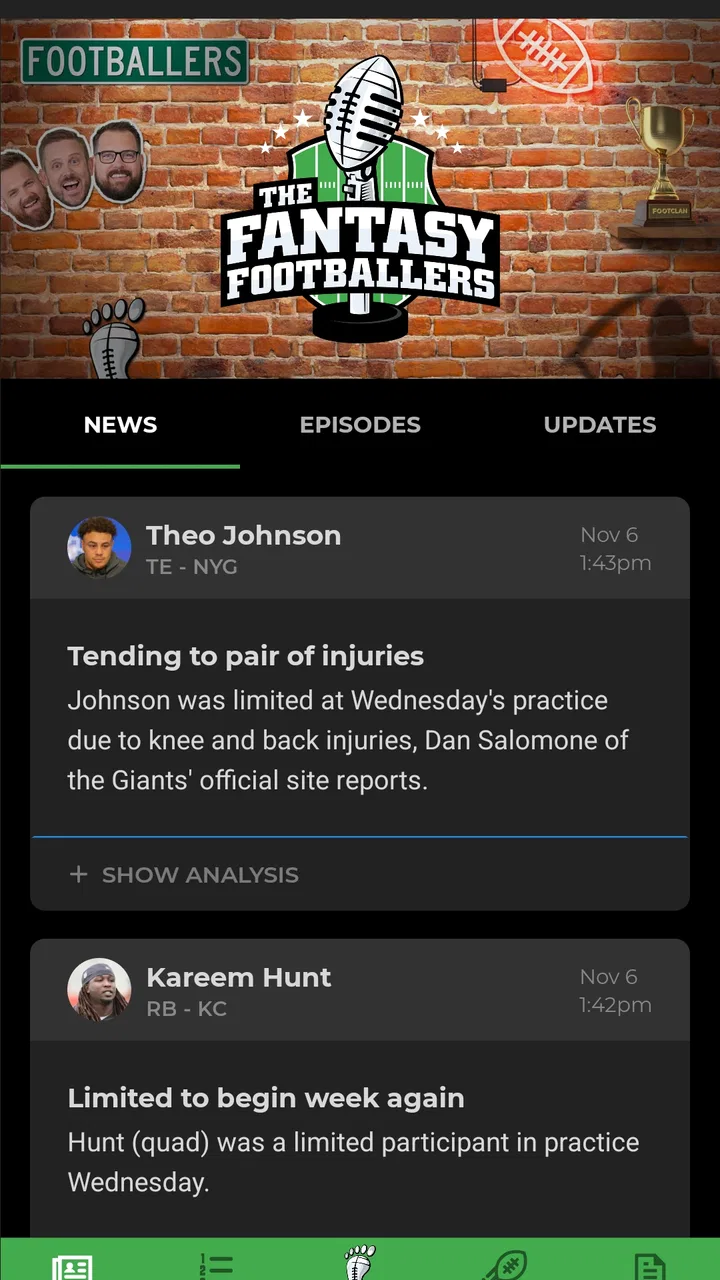
Fantasy Footballers
- 4.9
- Rating
- 10.00K
- Installs
- Free
- Price

 Analysis by App-foxy
I came to Fantasy Footballers looking for a practical way to make better fantasy football decisions without jumping between a podcast, a rankings page, and several separate tools. The app, created by The Fantasy Footballers, is built around that exact problem: bringing rankings, start-sit help, and related advice into one sports-focused place. After spending time with it, I found it most useful as a decision companion rather than a complete replacement for every part of a fantasy league.
The basic appeal is easy to understand. You open it when a lineup decision is bothering you, when you want a second opinion before waivers, or when Sunday is getting close and you need to revisit your starters. It is free to install, suitable for Everyone, and currently listed as version 6.0.2 for devices running Android 7.0 or later. There are optional in-app purchases ranging from $7.99 to $143.99 per item, so the free entry point is helpful, but anyone planning to use every paid part should look carefully at what is included before spending.
How I built a reliable weekly routine with it
My most useful approach was to treat the app as part of a repeatable fantasy football routine instead of opening it randomly whenever anxiety appeared. Early in the week, I would use the rankings to form a rough view of my roster. Later, I would return to the start-sit material when injury news, matchup concerns, or changing expectations made the original choice less comfortable.
You May Also Like

 AccuWeather: Weather Radar
AccuWeather Review: A Quick, Clear Forecast for Everyday Decisions
For everyday plans, the best forecast is the one you can understand quickly. AccuWeather makes rain timing, radar, and local conditions easy to act on, with a few trade-offs.

 Hill Climb Racing
Why Hill Climb Racing Still Turns Crashes Into One More Run
A tiny car, a bumpy hill and one more upgrade: Hill Climb Racing keeps resurfacing because its simple chaos makes every near-miss feel personal.

 AliExpress - Shopping App
AliExpress Makes Global Shopping Feel Personal, but Shoppers Bear the Risk
AliExpress turns a global marketplace into a pocket-sized discovery engine. Its reach is useful, its shopping loop compelling, and its trade-offs easy to miss.

 Lords Mobile: Kingdom Wars
Lords Mobile Is a Kingdom-Building Routine, Not a Quick Match
A case-by-case verdict on the building, battles, device demands, and social commitments that make Lords Mobile rewarding for some players and exhausting for others.

 PDF Scanner app - TapScanner
TapScanner Makes Paperwork Easier to Capture, Check, and Share
TapScanner makes scanning with a phone feel less like a rescue operation and more like a dependable step in getting work done. Its capture tools are useful, though not flawless.

 Block Blast!
 Shows How Much a Puzzle Game Can Leave Out
A quiet grid game shows why puzzle players increasingly value instant clarity, repeatable skill and low-pressure play—and where the genre still needs to catch up.
More From Our News Desk
View All News


That separation matters. Rankings are a broad starting point, while a start-sit decision is personal. A player can rank well overall and still be a poor fit for a particular roster if I need a safe floor, a high-upside swing, or a replacement for someone ruled out. I found that I made better choices when I first identified what my team needed and only then used the app to challenge my instinct.
A realistic Sunday example is a flex decision between a dependable veteran and a less predictable player with more upside. Instead of asking which name feels more exciting, I would check the current ranking view, read the relevant start-sit reasoning, and compare that advice with my league position. If I was heavily favored, the safer option could make more sense. If I needed a large score to catch up, the riskier choice might be justified. The app does not make that strategic decision for me, but it gives me a more organized basis for making it.
I also liked using it before setting a lineup, not after. Once games are underway, fantasy managers tend to search for reassurance rather than information. Checking earlier gives me time to notice uncertainty, reconsider a player, and avoid making a rushed change five minutes before kickoff. That habit is more valuable than constantly refreshing every opinion.
The rankings are especially useful as a common language for a league discussion. If a friend recommends a player, I can use the app to see whether that suggestion fits the wider evaluation. I do not treat the displayed order as an instruction. I treat it as a prompt to ask why one player is ahead of another and whether that difference matters for my scoring format.
That last point is important because fantasy football is not one universal game. League settings can change the value of touchdowns, receptions, passing production, and positional depth. A ranking that looks sensible in a general context may not perfectly match a highly customized league. My best workflow was therefore to use the app for a baseline, then apply my own league rules and roster situation before committing.
Small settings checks that prevent bad decisions
Before relying heavily on any fantasy tool, I would check how much of the experience reflects my own league. The first things I pay attention to are scoring format, roster requirements, and whether the view I am using is meant for a particular position or decision type. Even when an app presents information clearly, a mismatch between the advice and league rules can create false confidence.
I would also review account and notification settings rather than accepting every alert automatically. Timely information can be useful, but too many reminders can turn a helpful app into background noise. I prefer notifications that support a decision I actually need to make, especially around lineup deadlines, while avoiding a constant stream of updates that encourages needless tinkering.
Another practical check is whether the information on screen is current enough for the decision in front of me. Fantasy football changes quickly. A ranking used for a draft is not the same thing as a final lineup recommendation, and an early-week opinion may not account for later developments. I found it safer to look at the context of the page I was reading and return to the app when news had materially changed the situation.
The free price makes experimentation easy, but I would not assume that free access automatically covers every tool a serious manager might want. The app includes optional purchases, and the listed range reaches $143.99 per item. For a casual player, the free experience may be enough to decide whether the workflow fits. For a committed manager, the sensible approach is to identify the exact feature that would improve a real weekly task before buying anything.
I also recommend checking the app before a busy fantasy day rather than waiting until the moment a decision becomes urgent. This is less about the app itself and more about reducing friction. If I already know where the rankings and start-sit information are located, I can spend my limited time evaluating players instead of navigating under pressure.
Shortcuts that made the app more useful
The most effective shortcut was not a hidden button. It was keeping a consistent order of operations. I would start with my roster, identify the two or three decisions that actually mattered, consult the relevant rankings, and then read only the advice connected to those players. That prevented me from wandering through every available opinion and losing track of the original question.
I also learned to separate research from confirmation. During the first pass, I wanted information that could change my mind. During the second pass, I checked whether my final lineup still made sense. Mixing those stages can lead to endless switching, especially when two players are close in value. Once the app had helped me understand the range of outcomes, I tried to stop searching for a perfect answer that does not exist.
For draft preparation, I would use the rankings as a planning aid rather than a rigid script. I could mark the positions where my roster needed attention, compare the general order with my own preferences, and prepare alternatives in case another manager selected my preferred player. This is a useful distinction: rankings can organize a draft board, but they cannot know the exact behavior of the people in my league.
For weekly management, I found it helpful to write down why I made a change. If I moved a player into the lineup because of expected opportunity, matchup, or a concern about another player, recording that reason made it easier to judge the process later. The app supplied the research, while the note kept me from rewriting history after the result was known.
There is also a useful trade-off between speed and depth. When I had only a minute, the ranking view was a fast filter. When I had more time, the start-sit material gave me a chance to understand the reasoning behind a recommendation. I would not use the quick view as a substitute for deeper reading in a close matchup, but it was convenient for eliminating clearly weaker options.
Another habit was comparing app guidance with the actual needs of my matchup. A projected favorite does not always need the same kind of player as an underdog. I found the app more valuable when I used it to frame that decision instead of expecting it to know whether I should chase volatility. That is one of the clearest differences between an advice app and a personal fantasy strategy.
Where experienced use still has limits
The app’s strongest material is not a guarantee, and that limitation should be accepted before using it. Rankings and start-sit advice are estimates built for uncertain games. They can improve the quality of a decision, but they cannot remove injuries, unexpected game scripts, coaching changes, or ordinary randomness. If I wanted certainty, no fantasy football tool could provide it.
I also would not rely on one general ranking for every league format. A manager in a reception-heavy league, a superflex league, or a league with unusual roster rules may need to adjust the advice substantially. The app can still be useful as a starting point, but the more customized the league, the more work I have to do outside the app.
There is a similar limitation with personal roster context. A recommendation that looks attractive in isolation may be less useful when I already have several players from the same team, need to protect a narrow lead, or have no reasonable substitute if a late inactive announcement appears. The app helps me evaluate the player; I remain responsible for evaluating the roster.
Another point of friction is the temptation to overmanage. Having rankings and start-sit information close at hand can encourage constant lineup changes. I had to remind myself that a new opinion is not automatically a better opinion. If the underlying situation has not changed, repeatedly checking the same player usually adds stress rather than insight.
The optional purchase structure may also affect who gets the most value. Someone who only plays casually may prefer to stay with the free experience and use it for occasional checks. A manager who wants a broader, more regular toolkit may consider paid options worthwhile, but only after understanding how those purchases fit into an existing routine. I would not recommend paying simply because fantasy season feels urgent.
Compared with a basic rankings website, this app feels more convenient for someone who wants a focused mobile workflow. Compared with a league-management app, its value is different: it is centered on analysis and decisions rather than being the place where every league transaction must happen. Compared with social media advice, it offers a more structured way to review a question, although I still prefer to keep independent judgment and league-specific information in the process.
That comparison also explains who should skip it. If I only want a place to check scores, manage trades, or view league standings, this is not necessarily the first app I would choose. If I already have a trusted, format-specific system and never use rankings or start-sit analysis, adding another opinion may create clutter. It is better suited to managers who want help organizing decisions and who are willing to interpret advice rather than follow it blindly.
Who gets the most from the experience
I think the app is a strong fit for beginners who feel overwhelmed by the number of fantasy football opinions available. The combination of rankings and start-sit guidance gives them a place to begin, while the straightforward mobile format makes it easier to build a weekly habit. It can also help intermediate players who know the basics but want a faster second opinion before making a difficult call.
More experienced managers may appreciate it for a different reason. Instead of using it as an authority, they can use it as a checkpoint against their own assumptions. If my preferred player is ranked lower than expected, that difference gives me something specific to investigate. If the app agrees with my view, I still need to decide whether the recommendation suits my matchup. In both cases, the value comes from disciplined comparison.
The app is less suitable for anyone who expects an automatic lineup optimizer to understand every personal preference. It does not replace learning league rules, watching late status updates, or thinking about risk. It also should not become the only source of information for managers who play in unusual formats. The more specialized the league, the more carefully I would adapt what I see.
Its audience is reflected in the response so far: the app holds a 4.9 average from around 2.8 thousand ratings, with over 10 thousand installs. Those figures suggest that it has found a receptive group of fantasy football users, though popularity alone is not a reason to follow every recommendation. I would judge it by whether it improves my own process, not by the size of its audience.
The developer name is also central to the app’s identity. The Fantasy Footballers are not presented here as a generic sports publisher; the product is built around their fantasy football perspective. That can be appealing if I already enjoy their style of analysis, while someone looking for a completely neutral, highly customized statistical dashboard may prefer a different kind of tool.
My verdict after making it part of the routine
After using it as a weekly companion, I see Fantasy Footballers as a focused aid for rankings and lineup decisions, not a magic answer machine. Its best quality is the way it can turn a vague question—“Who should I start?”—into a more manageable process: establish a baseline, examine the reasoning, consider the league context, and make a decision before panic takes over.
I especially recommend it to players who want to replace scattered searching with a repeatable habit. Start with the roster, check the relevant ranking, read the connected start-sit discussion, and then stop once you have enough information to act. That workflow makes the app more useful than simply opening it repeatedly throughout the day.
The limits are meaningful but reasonable. Advice can become outdated as circumstances change, general rankings may not match unusual scoring systems, and optional purchases mean the full experience may require a closer look at spending. None of those issues makes the app poor; they simply define the kind of user who will benefit most.
It was released on August 31, 2023, and its current version is 6.0.2, with support beginning at Android 7.0. The free starting point and Everyone age rating make it easy to try, while the sports focus keeps the purpose clear. I would install it if I wanted a convenient, recognizable source for fantasy football rankings and start-sit thinking. I would skip it only if I needed league administration first, played a highly specialized format, or already had a decision system that another opinion would merely complicate.
My final recommendation is simple: use it as a thoughtful checkpoint, not as a substitute for judgment. When I combined its guidance with league settings, roster needs, and a consistent checking routine, it helped me make faster and calmer choices. The real advantage is not blindly following a ranking; it is building a repeatable decision process around the information.
FAQs for Fantasy Footballers
01What is Fantasy Footballers, and what can I do with the app?
Fantasy Footballers is a companion app for fantasy football fans who want advice, rankings, news, and analysis in one place. It is designed around the Fantasy Footballers brand and can help you prepare for drafts, evaluate trades, manage weekly lineups, and follow player updates. The app is most useful when combined with your existing fantasy league platform, since it may not replace the official app used to set lineups or submit transactions.
02Does Fantasy Footballers support my fantasy football league directly?
The app primarily provides fantasy football content and tools rather than functioning as the official management platform for every league provider. Depending on the current version, certain features may connect with supported services, but league compatibility should be checked before downloading. You may still need a separate app such as your league provider’s official application to make roster changes, add players, accept trades, or view live scoring.
03What type of fantasy football advice and tools are included?
Users can generally expect player rankings, projections, matchup analysis, injury information, waiver-wire suggestions, trade perspectives, draft preparation resources, and weekly start-or-sit guidance. The app may also include podcasts, articles, videos, alerts, and premium tools. Because fantasy recommendations change quickly, the value of the app depends on current updates, your league’s scoring rules, and how carefully you compare the advice with your own roster situation.
04Is Fantasy Footballers free to download, or does it require a subscription?
Fantasy Footballers may offer free access to selected content while reserving some advanced features, tools, or exclusive material for a paid membership or subscription. The exact pricing and available benefits can vary by platform and may change over time. Before confirming a purchase, review the in-app subscription screen carefully, including renewal terms, trial conditions, and cancellation instructions, especially if you only want basic rankings or news.
05Is Fantasy Footballers useful for beginners as well as experienced players?
Yes, the app can be useful for both new and experienced fantasy managers. Beginners may benefit from explanations, draft guidance, rankings, and waiver advice that make unfamiliar decisions easier to understand. More advanced users can use the analysis as a second opinion when comparing players or trades. However, no recommendation guarantees success, so you should still learn your league settings and make decisions based on roster needs and risk.
Pros
- Expert analysis helps inform fantasy lineup and waiver decisions.
- Daily episodes make it easy to keep up with NFL news and trends.
- Player rankings and projections support quick draft preparation.
- Community interaction adds entertainment and different fantasy perspectives.
- Content is useful for both beginners and experienced fantasy managers.
Cons
- Some advice may feel subjective or conflict between different analysts.
- Frequent notifications can become distracting during the fantasy season.
- Premium content may be needed for the most advanced tools and features.
- The app focuses heavily on NFL fantasy football rather than other sports.
- Large amounts of content can make it difficult to find specific advice quickly.

Fantasy Footballers
Gallery